

Introduction to a Sit-In
Published in LOOK, January 3, 1961, page 36b-36f.
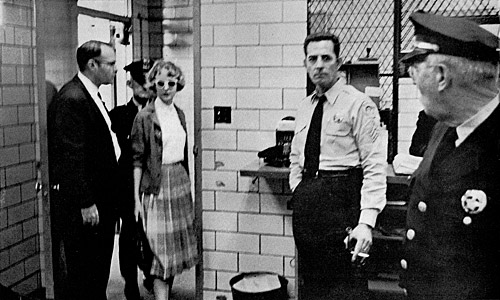
Sissy ordered food at the white counter, then left it for two Negroes to eat and sat at the Negro counter where a Negro shared his food with her. Photographer V. Thoma Kersh sneaked [this...] picture as Sissy is taken into the police station. Most Southern city officials seem anxious to prevent sit-in activity from being publicized.
Margaret (Sissy) Leonard is a native-born Southern girl who believes strongly that racial discrimination is cruel and unjust. An increasing number of young white Southerners feel the same way. Sissy is one of those who are putting their beliefs to the test of action. As a sophomore on full scholarship at Sophie Newcomb College in New Orleans, she has much to lose by public avowal of beliefs rigidly opposed by most of the adult community. In spite of this, Sissy recently went to a meeting of the local chapter of CORE (Congress on Racial Equality) and offered to take part in any kind of demonstration protesting segregation. Her offer was accepted, and she was given an important role in a lunch-counter sit-in planned for an afternoon in October. On the following page, she reports what happened.
The Police Ask Sissy if She is Really Southern
This is Sissy's story. (Editor's note: After the first sit-in Sissy Leonard wrote a remarkably understated report to CORE, which, in part follows.) "After I had finished sitting at the white counter and had sat at the Negro counter for a while, one of the Negro boys told me to leave and meet them at the library. I got up and started to follow a Negro girl who looked familiar and seemed to want me to follow her.
"About halfway to the door, a woman took my arm and asked me to go with her. She told me she was a policewoman. Several policemen then talked to me. One asked me if I was a Southern girl. I said yes, I was raised in Macon, Ga., and Atlanta. He asked why, as a Southern girl, I was doing this, and I said something about wanting to demonstrate how I felt about discrimination. He said he knew that, buy why did I feel that way? I just said I always had.
"The policemen led me and the two Negroes at the white counter out of the store, past a lot of staring people, and put us in a car to go to the police station. When we got there, we each went to a separate room, and I was questioned first. The police were very nice to me, and I was very nice to them too. They asked me how I got in CORE and how the demonstration was planned. I had been told to tell the truth, and I was eager to appear well-bred and co-operative and normally law-abiding, so I told them everything except the names of the two Sophie Newcomb girls who had wanted to sit in with me, but didn't. They asked if I had received any money from CORE, and also if I thought CORE was trying to make money. I said no, of course not, to both questions, and said that I thought CORE needed money pretty badly. They wanted to know, again, why I as a Southern girl would do such a thing if I didn't get any money. That seemed sort of absurd to me, but again I said something about wanting to demonstrate how I felt about discrimination. They asked if I knew what this could lead to, and I started to tell them that I was willing to risk being kicked out of school if it had to be that way. But they didn't mean my own personal consequences; they meant damage to the community or something. I tried to explain that we thought if we did these things peacefully and refused to be violent ourselves, there wouldn't be any violence at all and that any results would be good ones. I said that I, personally, just didn't like segregation and hoped to be able to help end it. They tried, a little, to talk me out of this. They told me that no Negroes would put themselves out in any way for me, and I said yes, they would. They said only in small ways, and all I could say was that they knew I felt very strongly they were wrong. I also said that right now the Negroes need more help than I do, but they disagreed with that too.
"The point is we don't treat Negroes right."
"Then one policeman started saying that Africans had been here for two thousand years, and what had they contributed to art, science or literature? I don't know anything about art, science or literature, but I said that I was an anthropology major and mumbled something about the influence of climate and geography on the development of cultures. Besides, I said, that isn't the point. The point is that we don't treat Negroes right. They disagreed here, too, but we were all being polite. Then they asked me if I knew there was an organization advocating black supremacy and the raping of white women? I said no, I didn't know that. Finally, the captain said that they had better hush, or I would think they were prejudiced. I laughed and said they were right; I sure would thing that.
"All along, everybody I talked to seemed surprised that I was from Newcomb and an authentic Southern girl, and I was pleased to be Southern and on a scholarship at Newcomb, and not some odd-ball Yankee rabble rouser. The police finally told me to go back to my minister and think very seriously before I ever did this again. I agreed to think seriously, although of course I already have. They told me I was free to go, and I went."
Sissy Leonard has continued helping CORE in its demonstrations against segregation. Officials of Sophie Newcomb College, while disapproving of Sissy's actions, have supported her right to express personal beliefs.
Of the people who have criticized her for being "naive" and "impractical," Sissy told LOOK: "I keep being surprised at people who talk about being starry-eyed and young and naive. When it comes to choosing, most of them don't really think and choose; they just automatically think about themselves and call it 'judgment.' I thing I see things more clearly than they do; I know exactly what's going on in the way of outright cruelty and morally wrong discrimination. I also know I'm not going to change the world more than one particle. But there people with 'good judgment' aren't doing anything at all."
